Why most vibe-coded games feel terrible (and how to fix it)
Vibe coding can produce a working game in minutes. But 'working' and 'worth playing' are two very different things. Here's what's going wrong — and what it takes to fix it.
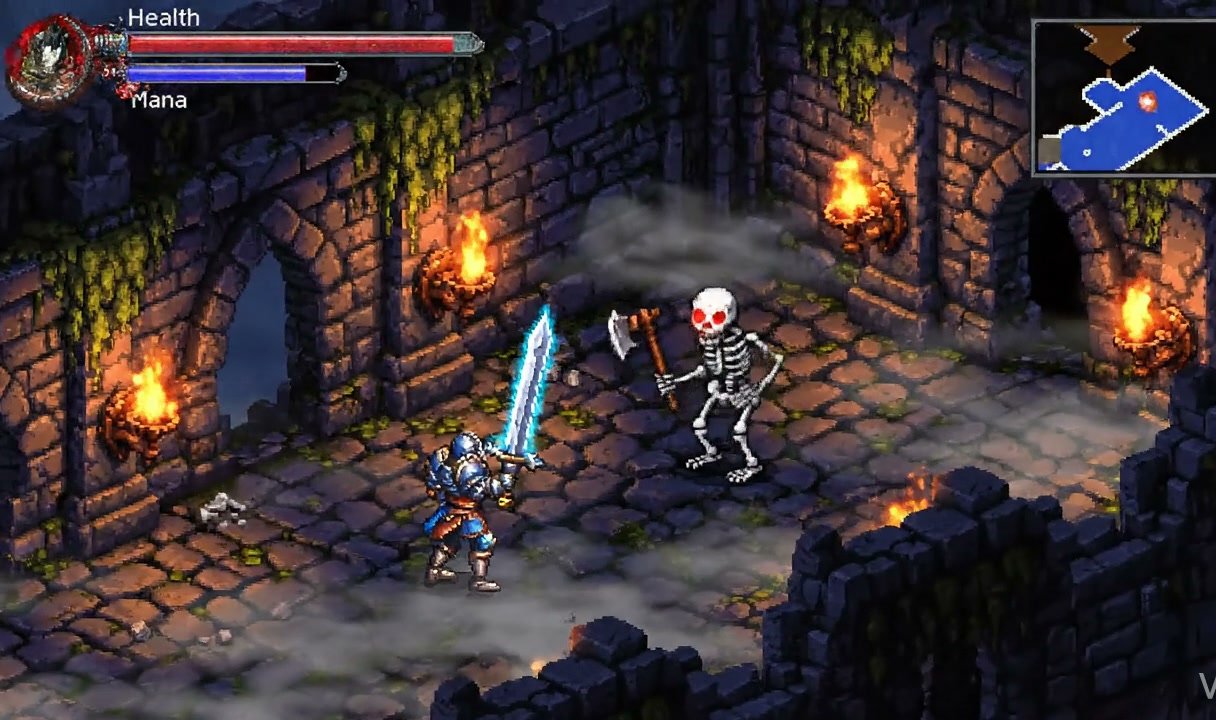
Vibe coding is genuinely impressive the first time you see it.
You open a chat window, type "make me a top-down RPG with combat and loot drops," and sixty seconds later you're looking at a playable game. A character walks around. Enemies exist. You can swing a sword and things die. There's even a health bar.
Then you actually play it for thirty seconds. And something is deeply, unmistakably wrong.
The sword doesn't feel like it's hitting anything. The enemies just... stop existing when their health reaches zero. Moving your character feels like dragging a box across a spreadsheet. And somehow, despite having all the right pieces, it feels like nothing at all.
This isn't a vibe coding hate piece. The technology is remarkable and it's only getting better. But there's a consistent, predictable gap between what vibe coding produces and what people actually want to play — and understanding that gap is the first step to closing it.
The five things vibe-coded games consistently get wrong
After playing dozens of vibe-coded games across every genre, the same problems appear over and over again. They're not random bugs. They're systematic blind spots.
1. Controls feel stiff and unresponsive
Fire up a vibe-coded racing game and try to steer. The car snaps instantly to whatever direction you press — no turning radius, no drift, no weight transfer. It doesn't feel like driving. It feels like pivoting a rectangle.
This happens because the generated code maps input directly to state. Press left, the car faces left. There's no acceleration curve, no momentum, no smoothing between states. In a real racing game, steering input feeds into a physics model that simulates tire grip, weight distribution, and angular momentum. The car resists your input slightly, and that resistance is what makes it feel like a car instead of a cursor.
The same problem shows up everywhere. Characters in platformers start and stop instantly. Aiming in shooters has no inertia. Puzzle pieces snap to grid positions with zero animation. Every interaction feels binary — on or off — when it should feel analog.
2. Actions produce zero feedback
Swing a sword in a vibe-coded RPG. What happens? The attack animation plays. The enemy's health number decreases. That's it.
No hit-stop. No screen shake. No impact particles. No knockback on the enemy. No camera punch. No satisfying crunch sound. The most dramatic moment in combat — connecting a weapon with an enemy — registers with all the impact of clicking a button in a spreadsheet.
Feedback is how players understand consequence. When a hit feels powerful, the player feels powerful. When a hit feels like nothing, the entire combat system feels like nothing. And vibe coding almost never generates feedback systems because they don't appear in functional descriptions. Nobody types "make the screen shake for 4 frames on a heavy attack with a 3-pixel amplitude that decays exponentially." But that's exactly the kind of detail that makes combat feel alive.
3. The camera is an afterthought
Most vibe-coded games have one of two camera modes: completely static, or rigidly locked to the player's position. Both feel terrible.
A static camera means the player runs off the edge of the screen. A locked camera means every tiny movement creates a jittering, nauseating frame. Neither approach anticipates where the player is going, creates drama during key moments, or gives the player a sense of space.
Good camera work is invisible — you never think about it in a polished game. But bad camera work is immediately obvious. It's the difference between watching a movie and watching security footage.
4. Difficulty is completely untuned
Vibe-coded games tend to be either trivially easy or impossibly hard, with nothing in between. There's no difficulty curve — no gradual introduction of mechanics, no escalation of challenge, no pacing.
A vibe-coded puzzle game might dump every mechanic on you in the first level. A vibe-coded action game might spawn enemies with perfectly tuned damage values... that happen to kill you in one hit. Or enemies so weak they pose zero threat.
Difficulty tuning is inherently iterative. It requires playing the game, feeling what's too easy or too hard, adjusting, and playing again. It can't be specified in a prompt because the right values depend on the feel of the game in motion — something you can only know by experiencing it.
5. UI feels like a wireframe
Open the inventory in a vibe-coded RPG. The panel appears instantly — no slide-in, no fade, no easing. Click a potion and it vanishes from the grid. Equip a weapon and the stat numbers change with no transition. Close the menu and it blinks out of existence.
Every UI interaction is instant. And "instant" feels broken.
Real game UI has rhythm. Menus slide in with a slight overshoot and settle back. Items animate into position. Numbers tick up or down rather than snapping. Tooltips fade in with a tiny delay. Close a menu and it collapses with a satisfying whoosh.
These animations aren't decoration. They're communication. They tell the player "something happened" and "here's what changed." Without them, the UI feels like a developer tool rather than part of a game.
Why better prompts won't fix this
The natural instinct is to write better prompts. Be more specific. Describe exactly what you want.
"Make a racing game with realistic steering physics, tire grip simulation, smooth camera follow with look-ahead, engine sounds that pitch with RPM, particle effects for tire smoke when drifting, and a difficulty curve that starts with wide tracks and introduces tighter corners over time."
That's a better prompt. And it might get you incrementally closer. But it won't get you to a game that feels good, for a fundamental reason: game feel is the result of hundreds of micro-decisions that interact with each other in ways you can't predict upfront.
How much look-ahead should the camera have? It depends on the car's top speed, the track width, and the turn frequency — values you don't know until the game exists. How aggressive should the tire smoke particle system be? It depends on the visual style, the camera distance, and whether it obscures important gameplay elements.
Each of these decisions is small. But they compound. A game has hundreds of them, and they all affect each other. You can't specify them in a prompt because you don't know the right values until you play the game and feel what's wrong.
This is why professional game developers spend weeks on polish. Not because they're slow, but because polish is discovered through iteration, not described through specification.
What "fixing it" actually looks like
If prompts can't solve this, what can? Three things.
A dedicated polish pass — by default
Game feel can't be an optional add-on. It needs to be a core part of the generation pipeline. Every mechanic that gets created should automatically receive feedback systems: visual effects, audio cues, camera reactions, and animation polish appropriate to the game's genre and tone.
A sword swing in a dark fantasy RPG needs different feedback than a sword swing in a cartoon brawler. But both need something. The polish pass has to be context-aware, not generic.
Feedback systems that understand context
Screen shake isn't one thing. It's a spectrum. A light attack might get a 2-pixel shake for 3 frames. A heavy attack might get an 8-pixel shake for 6 frames with a different decay curve. A boss slam might shake the screen, zoom the camera, pause gameplay for a beat, and crack the ground.
The system applying polish needs to understand the hierarchy of actions in the game and calibrate feedback accordingly. Not everything can be max intensity — that's just as bad as no feedback at all.
Real iteration, not one-shot generation
The first pass is never right. Game feel requires a loop: generate, play, identify what's off, adjust, play again. The tool needs to support this loop natively — letting creators say "the steering feels too twitchy" or "hits need more weight" and translating that into concrete parameter changes across multiple systems simultaneously.
This is the problem we're solving
Exekite exists because we believe the gap between "vibe-coded prototype" and "game worth playing" shouldn't require a team of experienced developers to close.
Our platform treats game feel as a first-class discipline, not an afterthought. Every game generated through Exekite ships with feedback systems, tuned controls, camera behavior, and UI polish built in from the start — calibrated to the genre, tone, and style of the game you're making.
Vibe coding opened the door. Now it's time to walk through it and build something players actually want to keep playing.